Program Overview
The Diploma in Optical Dispensing & Ophthalmic Optics is a professionally oriented program designed to prepare students for clinical, technical, and commercial roles in the optical and eye-care sector. The program focuses on the scientific principles of optics, ophthalmic lens design, frame fitting, visual correction systems, and optical laboratory technologies, while ensuring alignment with international occupational competency standards.
Graduates acquire the theoretical knowledge and hands-on skills required to safely dispense ophthalmic lenses, support optometrists and ophthalmologists, and operate modern optical laboratories.
Program Goals
The program aims to:
Develop competent optical dispensing professionals with strong technical accuracy
Equip students with applied skills in lens calculation, fitting, and verification
Ensure compliance with international optical safety and quality standards
Prepare graduates for employment or further academic progression in eye-care fields
Foster ethical practice, patient communication, and professional responsibility
Program Learning Outcomes (PLOs)
Upon successful completion of the program, graduates will be able to:
Explain fundamental principles of geometrical and ophthalmic optics
Interpret optical prescriptions accurately and safely
Calculate, verify, and dispense ophthalmic lenses according to standards
Select, fit, and adjust frames based on anatomical and visual needs
Operate optical laboratory equipment and edging systems
Apply infection control, health & safety, and quality assurance protocols
Communicate effectively with patients and eye-care professionals
Demonstrate professional ethics and legal awareness in optical practice
Program Structure
Year 1: Foundations of optics, vision science, and basic dispensing skills
Year 2: Advanced ophthalmic optics, applied laboratory practice, and professional integration
Each academic year consists of theoretical modules, laboratory sessions, and clinical simulations.
Program Curriculum & Module Learning Outcomes
Year 1 – Foundations
Introduction to Vision Science
Understand basic ocular anatomy and visual function
Geometrical & Physical Optics
Apply laws of refraction, reflection, and image formation
Ophthalmic Lenses I
Identify single-vision lenses and basic lens materials
Optical Mathematics & Lens Calculations
Perform prismatic, focal length, and decentration calculations
Frame Technology & Facial Measurements
Select and fit frames based on facial anatomy
Professional Practice & Ethics
Apply ethical and legal principles in optical dispensing
Year 2 – Advanced Practice
Ophthalmic Lenses II (Multifocal & Specialty Lenses)
Dispense bifocal, progressive, and occupational lenses
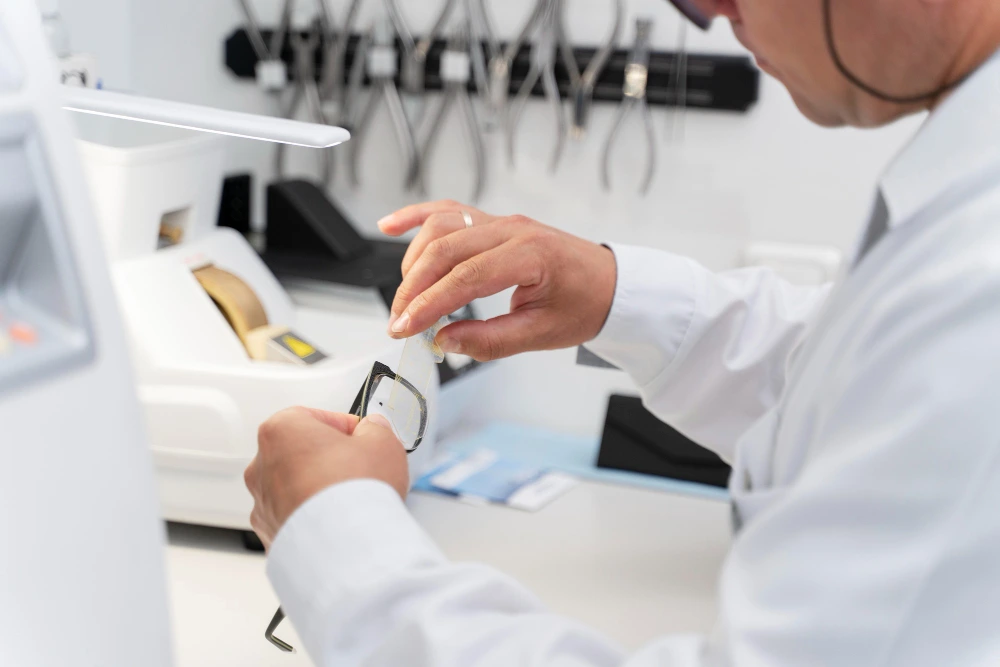
Optical Laboratory Techniques
Operate edging, mounting, glazing, and verification equipment
Low Vision & Special Visual Needs
Support patients with visual impairments
Contact Lens Fundamentals (Introductory)
Understand contact lens types and handling principles
Quality Control & Optical Standards
Apply ISO and ANSI ophthalmic lens standards
Work-Based Learning / Capstone Project
Demonstrate applied professional competence
Assessment Methods
Written examinations
Practical laboratory assessments
Prescription interpretation tests
Case studies and simulated patient scenarios
Coursework and assignments
Final applied capstone project
Assessment methods are aligned with competency-based education models used in optical training worldwide.
Entry Requirements
Applicants must meet one of the following:
High school diploma or equivalent
Level 3 qualification (or equivalent) in science or health-related fields
Mature students with relevant professional experience (subject to assessment)
English language proficiency may be required for non-native speakers.
Pathways Available
Graduates may progress to:
Bachelor’s Degree in Optometry (subject to local regulations)
Bachelor’s in Vision Science / Health Sciences
Advanced diplomas or certifications in optical technology
Professional licensing pathways where permitted by national authorities
Possible Career Options
Graduates can work as:
Optical Dispenser
Ophthalmic Optical Technician
Optical Laboratory Technician
Vision Care Assistant
Optical Sales & Practice Coordinator
Clinical Support Staff in eye hospitals and clinics
Employment settings include optical stores, hospitals, laboratories, and eye-care centers.
Local & International Awards (Institution-Issued & Partner-Recognized)
Graduates may receive or be eligible for:
AACTD University Diploma in Optical Dispensing & Ophthalmic Optics
Professional Certificate in Ophthalmic Lens Dispensing
Advanced Optical Laboratory Skills Certificate
Certificate in Optical Quality & Standards Compliance
The program is benchmarked against international professional bodies and standards such as:
ABDO (UK) Optical Dispensing competency frameworks
ISO standards for ophthalmic optics (ISO 21987, ISO 8980 series)
WHO eye-care workforce development guidelines
Academic & Professional Benchmarking (Sources)
This program is informed by and aligned with internationally recognized frameworks and guidelines:
World Health Organization – Eye Care Workforce & Vision 2030
https://www.who.int/teams/noncommunicable-diseases/sensory-functions-disability-and-rehabilitation/visionAssociation of British Dispensing Opticians (ABDO) – Education & Competencies
https://www.abdo.org.ukInternational Organization for Standardization – Ophthalmic Optics Standards
https://www.iso.org/committee/54904.htmlAmerican National Standards Institute (ANSI) – Ophthalmic Lens Standards
https://www.ansi.org